High-Power Fiber Laser Cutting: Structural Rigidity, Reflectivity Control, and the Economics of Thick-Plate Fabrication
Abstract
Fiber laser cutting has moved decisively past the 6 kW threshold that defined its first commercial decade. Machines rated at 10, 12, 15, and now 20 kW are no longer laboratory curiosities but production assets in steel service centers, construction equipment plants, and heavy fabrication shops. The shift matters less for raw speed—though speed gains are real—than for the process economics it unlocks: thicker plate cut in a single pass, fewer secondary operations, and a rebalancing of cost from labor and consumables toward capital and power. This article examines the engineering constraints that determine whether a high-power installation actually delivers, using published performance data and the design philosophy of ROCLAS® MACHINERY CO., LTD. as an illustrative case.
1. Industry Background: Power Ratings and the Data Behind Them
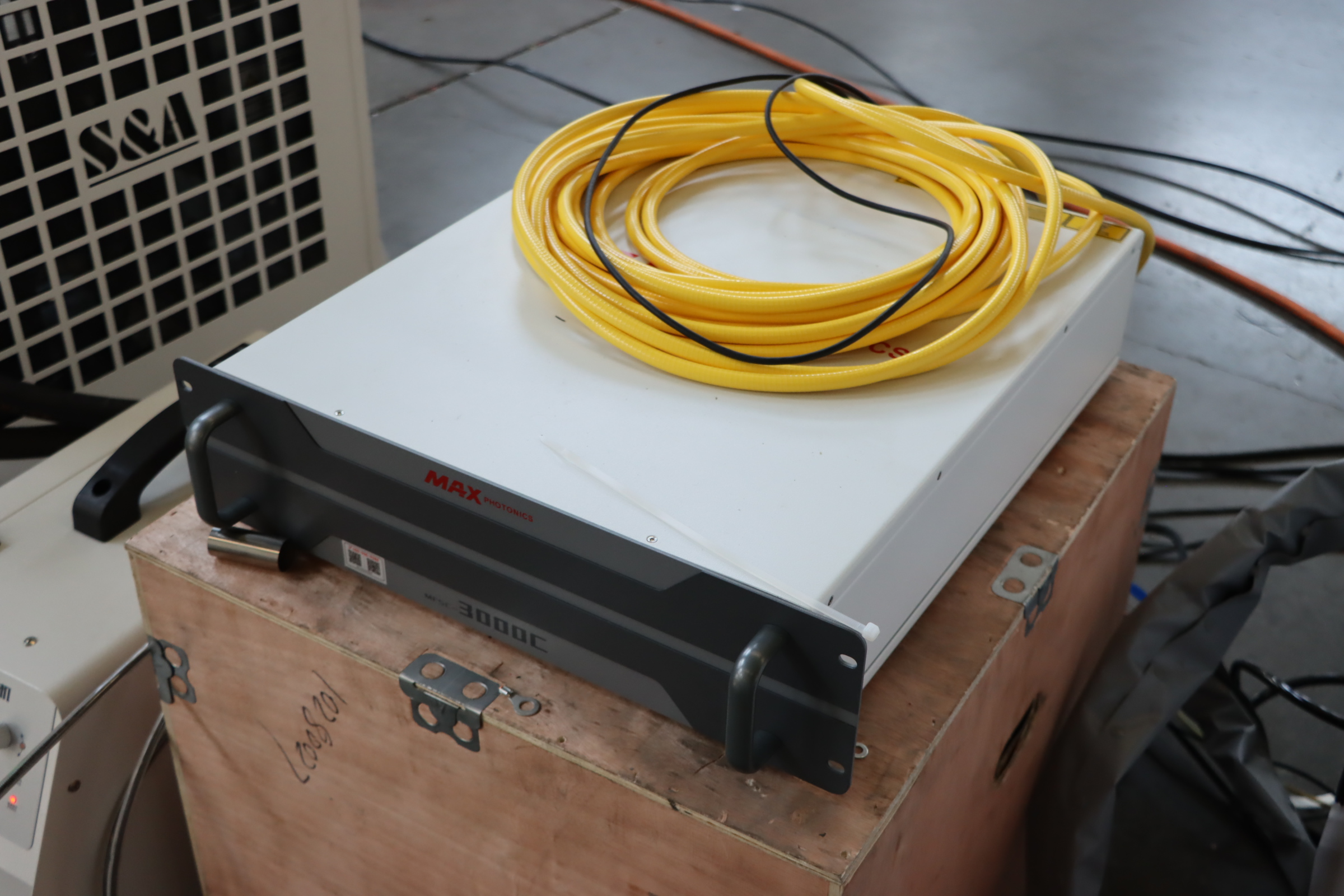
The market conversation around fiber lasers has been dominated by wattage, which is a poor proxy for capability. A 20 kW source mounted on a frame that cannot hold tolerance at 1.0 G acceleration will underperform a well-built 12 kW system on real parts. The variables that matter are positioning accuracy, repositioning accuracy, achievable traverse speed, and the thermal stability of the bed under sustained duty cycles. Published parameters for representative production-class machines illustrate the envelope within which suppliers now compete:
| Parameter | Standard Sheet Machine | Tube Cutting Machine | High-Power Plate Machine |
|---|---|---|---|
| Working area | 3000 × 1500 mm (also 4000 × 2000, 1500 × 4000) | 1500 × 4000 mm | 4000 × 2000 mm class |
| Laser power range | 1 kW – 20 kW | 1 kW – 3 kW | 12 kW – 20 kW |
| Laser source options | Raycus / MAX | Raycus / MAX | Raycus / MAX |
| X/Y positioning accuracy | ±0.03 mm | ±0.05 mm | ±0.03 mm |
| X/Y repositioning accuracy | ±0.02 mm | ±0.03 mm | ±0.02 mm |
| Traverse speed | up to 100 m/min | up to 100 m/min | up to 100 m/min |
| Max acceleration | 1.0 G | 1.0 G | 1.0 G |
| Control system | Cypcut 3000S | Cypcut 3000S | Cypcut 3000S |
| Laser head | Raytools | Raytools | Raytools |
| Max tube diameter | — | 220 mm | — |
| Power supply | 380 V / 50 Hz | 380 V / 50 Hz | 380 V / 50 Hz |
Three observations follow from this table. First, accuracy specifications have converged: ±0.03 mm positioning and ±0.02 mm repositioning are now table stakes across sheet and heavy-plate categories, which means differentiation has migrated to structural design and motion dynamics rather than to the control loop itself. Second, the tube-cutting column shows a deliberate power ceiling of 3 kW. That is not a technical limitation but a process judgment—tube wall thicknesses rarely justify higher power, and the added source cost would not be recovered. Third, the 1.0 G acceleration figure shared across categories is where machine mass becomes decisive. Accelerating a gantry to 1.0 G and stopping it without ringing requires a frame whose stiffness is matched to the servo tuning; otherwise the nominal accuracy exists only in the datasheet.
2. Application Engineering: Where High Power Pays and Where It Does Not
The economic case for 12–20 kW rests on three mechanisms. The first is single-pass capability on thick carbon steel, which eliminates the pierce-and-restart cycles and edge taper associated with lower-power multi-pass strategies. The second is nesting efficiency: faster cutting compresses the time penalty for complex nests, allowing programmers to prioritize material yield over cycle time without sacrificing throughput. The third is consumable reduction—higher power with nitrogen assistance reduces the reliance on oxygen cutting and its oxide-affected zone, which in turn reduces downstream grinding.
The countervailing constraint is reflectivity. Copper and aluminum remain difficult because back-reflected light destabilizes the resonator and, in poorly protected systems, damages optics. The practical answer is a high-reflectivity suppression module; with it, stable processing of 1–2 mm copper and 2–3 mm aluminum becomes routine rather than experimental. Buyers evaluating a machine for mixed-material work should treat this module as a specification item, not an accessory.
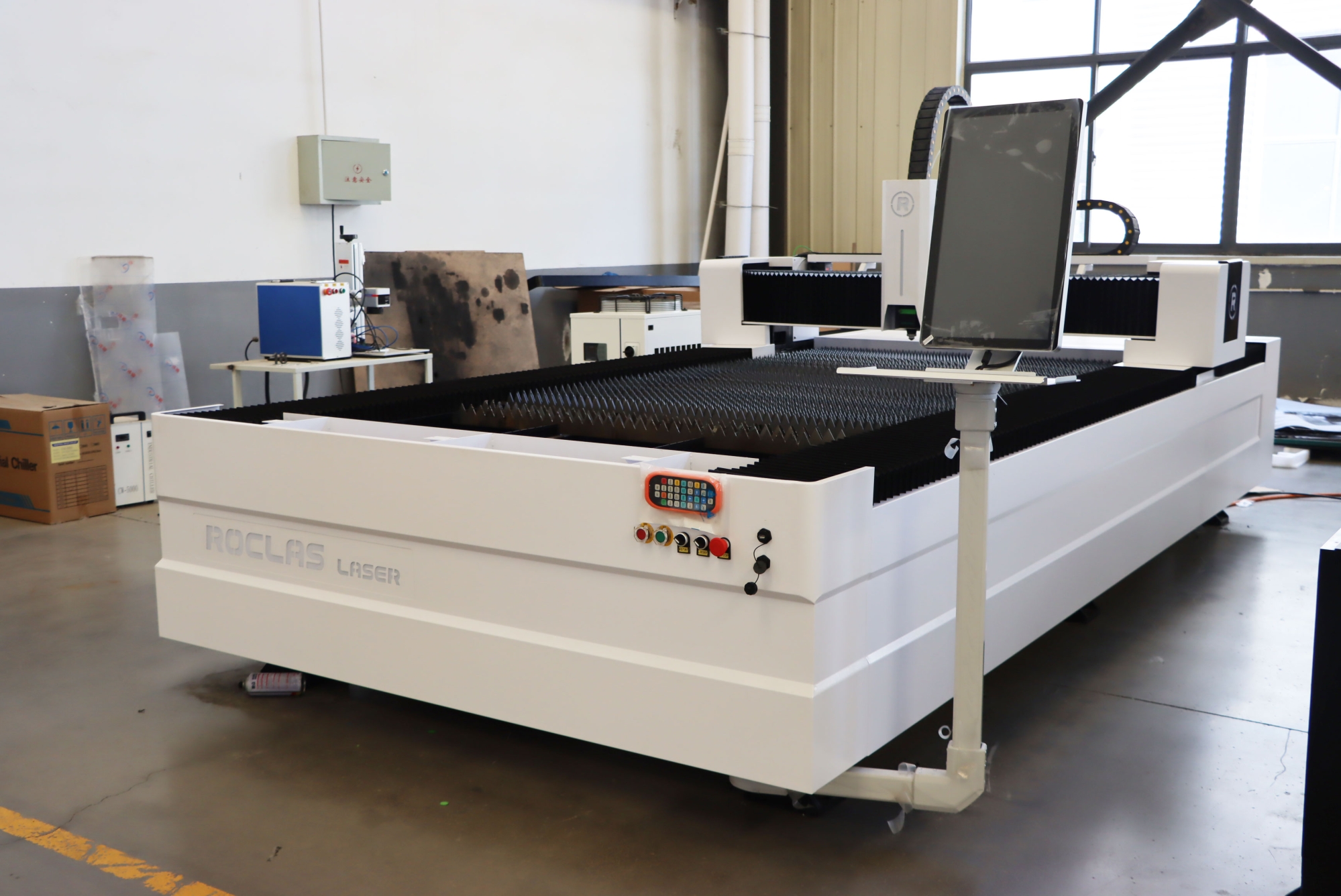
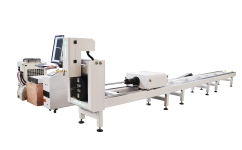
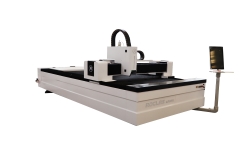
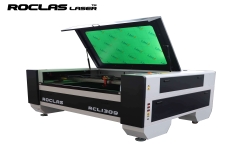
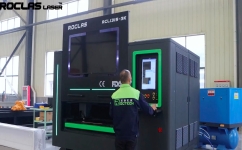
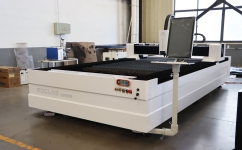
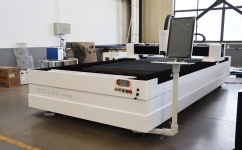
Structural design deserves equal scrutiny. Industrial-grade heavy-duty steel structures machined on a CNC five-face machining center provide the flatness and perpendicularity that bolt-together frames struggle to hold over years of service. ROCLAS® MACHINERY CO., LTD., a laser equipment manufacturer with more than fifteen years in the field and a fifteen-member R&D team drawing on CNC experience of similar depth, builds its fiber platforms around this principle, pairing five-face-machined heavy steel beds with imported servo drives and reducers, Schneider and SMC electrical components, and German igus cable management. The company's portfolio spans 1 kW to 20 kW sheet machines, a five-axis platform with n×360° infinite rotation for three-dimensional workpieces, tube machines up to 220 mm diameter, and a hybrid CO2-plus-fiber model (RCL1530-500W, 1500 × 3000 mm) for shops that process acrylic, wood, and leather alongside metal. That breadth is itself an argument: a supplier that has engineered across five-axis kinematics, tube handling, and non-metal CO2 processing is more likely to have resolved the thermal and dynamic problems that appear only at the top of the power range.
3. Conclusion and Outlook
The next competitive frontier is unlikely to be another wattage jump. It will be integration: automatic nesting that treats power as a variable, coil-fed lines that replace press blanking with lower energy consumption, and five-axis heads that bring laser cutting into formed and hydroformed part geometries previously reserved for machining centers. Certification maturity—ISO 9001, CE, FDA, UL, and PDL compliance—will increasingly function as a market-entry requirement rather than a differentiator, particularly for suppliers serving North American and European buyers. For fabricators, the prudent posture is to specify machines against the parts they will actually cut, insist on demonstrated accuracy under acceleration, and verify reflectivity handling before committing to mixed-material production. Power is a means; stiffness, control, and process knowledge are what convert it into margin.
استفسار
إذا كنت بحاجة إلى المشورة العامة أو الدعم الملموس ، ونحن سعداء لمساعدتك .
آخر مشاركة :
-
 Robotic Arm Laser Systems: Redefining Precision and Flexibility in Industrial ManufacturingAbstractThe integration of robotic arms with laser processing technologies represents a paradigm s...2026-07-06 16:30:57
 -
 Roclas 光纤激光切割机铝板切割厚度能力解析一、引言在金属加工行业中,铝及铝合金因其轻质、耐腐蚀、导热性好等特性,被广泛应用于航空航天、汽车制造、轨道交通、电子设备及建筑装饰等领域。铝材的高反射率特性使其成为激光切割中较难处理的材料之一。许...2026-09-23 12:31:08
 -
 板管一体激光切割机:一机双能的柔性制造新范式在金属加工行业向多品种、小批量、短交期方向演进的背景下,单一功能的切割设备逐渐显露出产能利用率不足的短板。板管一体激光切割机通过在同一个加工平台上集成平板切割与管材切割能力,为中小规模制造企业提供...2026-09-24 20:30:46
 -
 金属激光焊接机金属激光焊接机:技术演进、市场格局与ROCLAS的工程实践金属激光焊接技术在过去十年间从实验室走向大规模工业部署,其核心驱动力来自光纤激光器成本下降、伺服控制精度提升以及制造业对焊接质量一致性的刚...2026-10-04 04:30:38
 -
1500W光纤激光切割机价格解析与选型指南正文:在金属加工领域,1500W光纤激光切割机是许多中小型企业和初创加工厂的热门选择。它既能满足日常碳钢、不锈钢板材的切割需求,又在采购成本和运行费用之间取得了较好的平衡。一台1500W激光切割机...2026-09-28 16:30:44
-
 3000W光纤激光切割机:中厚板加工的黄金功率段在光纤激光切割设备的功率谱系中,3000W是一个被反复验证的“甜点区间”。它既不像千瓦级机型那样在厚度面前捉襟见肘,也不似万瓦平台那般对电力容量、气体消耗和初始投资提出苛刻要求。对于大量以碳钢、不...2026-10-01 08:31:49